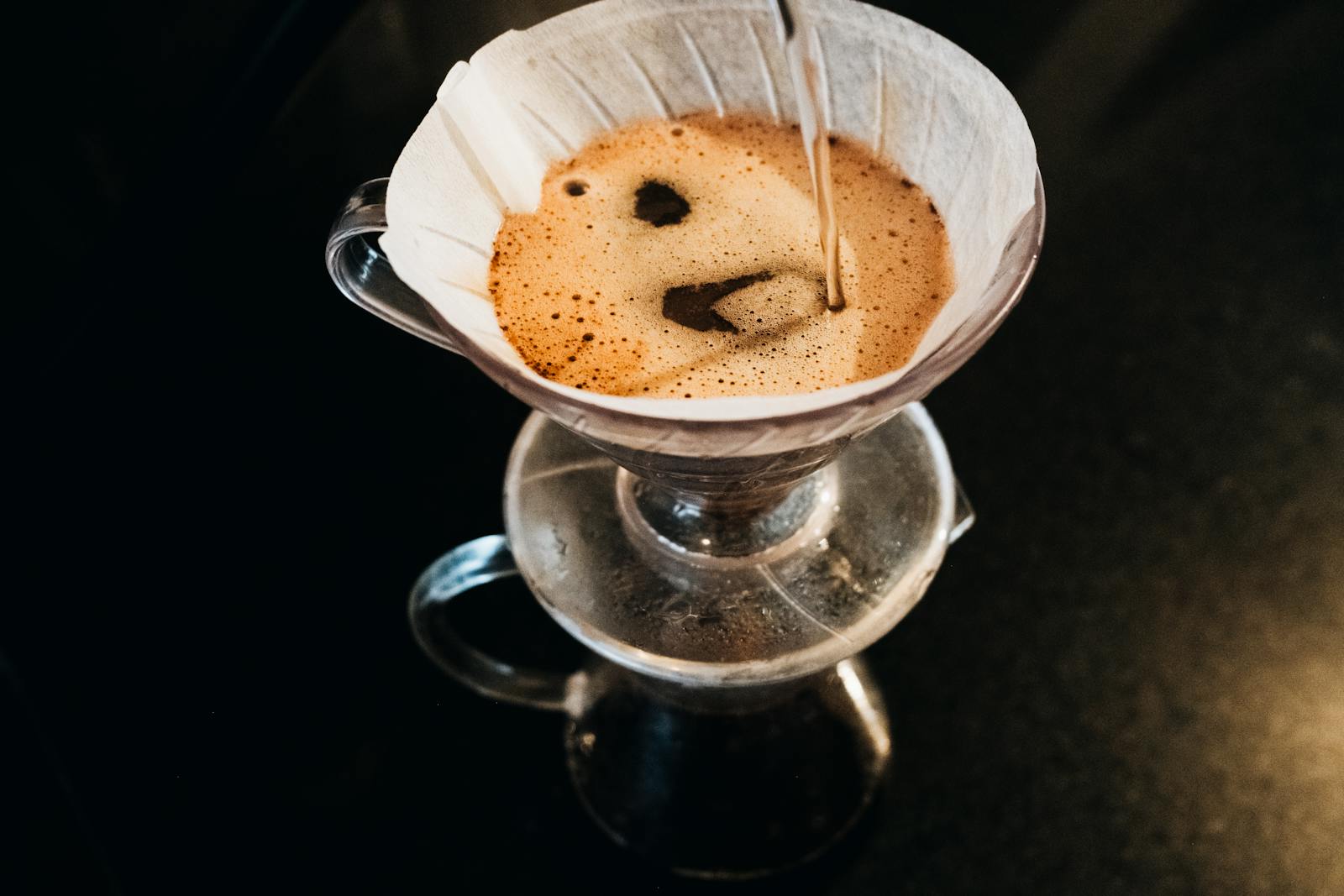
Drip Coffee Gear
The Drip.
Every piece of gear
between you and a
perfect cup.
The gear is what gets you there.
The gear is what gets you there.
A pour-over is hot water, ground coffee, and a filter. That is the whole thing. And still, the difference between a bad cup and a great one is enormous.
The variables are small in number. Water temperature. Grind size. Ratio. Pour technique. Time. Miss any of them and the cup goes flat. Hold them steady and coffee you thought you knew tastes like something you have not had before.
The gear is never the point. The gear is what lets you control the variables long enough to understand them.
You don't need a shelf of gear to pull a great cup. These three pieces get you a brew that will embarrass most cafe drip.

The cone that started the modern pour-over moment. Ceramic holds temperature, the spiral ribs let air escape cleanly, and the single large hole gives you control over the pour. Made in Japan since 2005.

Tabbed, bleached, cone-shaped. Rinse them before brewing to remove the paper taste and seat the filter against the cone. A hundred filters is three months of daily coffee.

A narrow spout is non-negotiable for pour-over. The gooseneck lets you control flow rate and target the bed evenly. No thermometer, no temperature display, just a kettle that pours where you aim it.
Fifty to two hundred. This is where a home brew starts to beat most cafes. Precision instead of approximation.

Variable temperature to the degree. Hold function. A pour spout engineered on purpose. The dial is on the base so you read it without moving the kettle. This is the one that replaces your stovetop for good.

Forty grind settings. Conical steel burrs. Serviceable and user-rebuildable, with parts you can still buy ten years from now. The grinder that has lived on a million counters. If you only upgrade one thing from the Essentials kit, it is this.

Weighs and times in one view. Reads to one tenth of a gram. You pour to a target weight, not a guess. The single change that fixes most home brewing faster than any other upgrade.
You are past a coffee habit. You are inside a discipline. These three pieces are the ones people build their counter around.

64mm flat burrs tuned for filter coffee. Single-dose loading, anti-static system, almost zero retention. The grind clarity shows up in the cup. You taste things you were missing.

Twenty measurements per second. Auto-tare on pour, brew timer that starts on weight change, app connectivity if you want the data. The scale that shows up on every competition bench for a reason.

Hardened steel conical burrs. Fifty turns of the handle for a full dose. A travel grinder that outperforms most electric ones at any price. Made in Germany. Has outlasted phones and relationships.
Three categories sit next to your dripper. Get one right in each and you are done shopping for a long time.
A regular kettle glugs. A gooseneck pours in a controllable stream. Variable temperature matters more than you think, because 200°F tastes different than 212°F in the cup.
Blade grinders hack beans into uneven pieces. Burr grinders cut uniformly. Uniform grind means uniform extraction. This is the upgrade that changes the cup fastest.
You cannot hold a ratio if you do not weigh. A one-tenth-gram scale with a timer is the single most underrated piece of pour-over gear. It removes guesswork.
Every hobby has a vocabulary. Coffee's is unusually honest. Each term here describes something concrete you can measure, feel, or taste.
The CO2 release when you first wet fresh grounds. They puff up and foam for 30 to 45 seconds. Beans older than two weeks barely bloom at all. A fresh bag should look alive.
The total brew time from first pour to empty cone. Target 3:00 to 3:30 on a standard V60. Faster than that means under-extracted. Slower means you pulverized the grind.
How fast water goes onto the bed. Slow, even spirals build a uniform wet layer. Rushing the pour channels water through one path and extracts unevenly.
How coarse or fine the coffee is. Pour-over sits at medium, roughly 700 microns, the texture of coarse sand. Finer stalls the flow. Coarser lets water shoot through.
The percentage of soluble compounds pulled from the coffee. Target is 18 to 22 percent. Under-extracted tastes sour and thin. Over-extracted tastes bitter and hollow.
Total dissolved solids. How much coffee is actually in your water, read off a refractometer. Pour-over sits at 1.25 to 1.45 percent. The truly obsessed own one.
One gram of coffee to 15 to 17 grams of water. Start at 1:16 and adjust. Almost every complaint about a cup being too weak or too strong is a ratio problem, not a bean problem.
